A concealed-carry belt does a job an ordinary belt never has to: it carries weight all day without letting a holstered pistol sag, roll, or print. Get it wrong and even a good holster tilts away from your body, digs into your hip, or shifts every time you sit down. Get it right and the whole setup disappears under a shirt. This guide walks through the main carry situations and what leather specification actually suits each one, so you can order a belt matched to how you carry rather than guessing.
Start with the carry method, not the belt
The single decision that drives every other spec is how you plan to carry. Inside-the-waistband (IWB) carry tucks the holster and part of the belt between your body and your trousers, so the belt needs enough length to route through the holster clips and enough stiffness to keep the grip pulled in. Outside-the-waistband (OWB) carry hangs the holster off the belt, which puts far more leverage on it; a heavier gun on an OWB rig is the toughest test a belt faces. Appendix carry sits the holster at the front, where belt rigidity keeps the muzzle end from levering outward when you bend. If you carry more than one way, spec for the most demanding method you use regularly rather than the lightest.
A gun belt differs from a dress belt mainly in stiffness across its width. A good concealed-carry belt resists twisting along its length, so the holster stays vertical instead of rolling toward the ground under the weight of the firearm. That resistance comes from thicker leather, a second bonded layer, or a stiffening insert, and it is the property that matters more than any cosmetic detail.
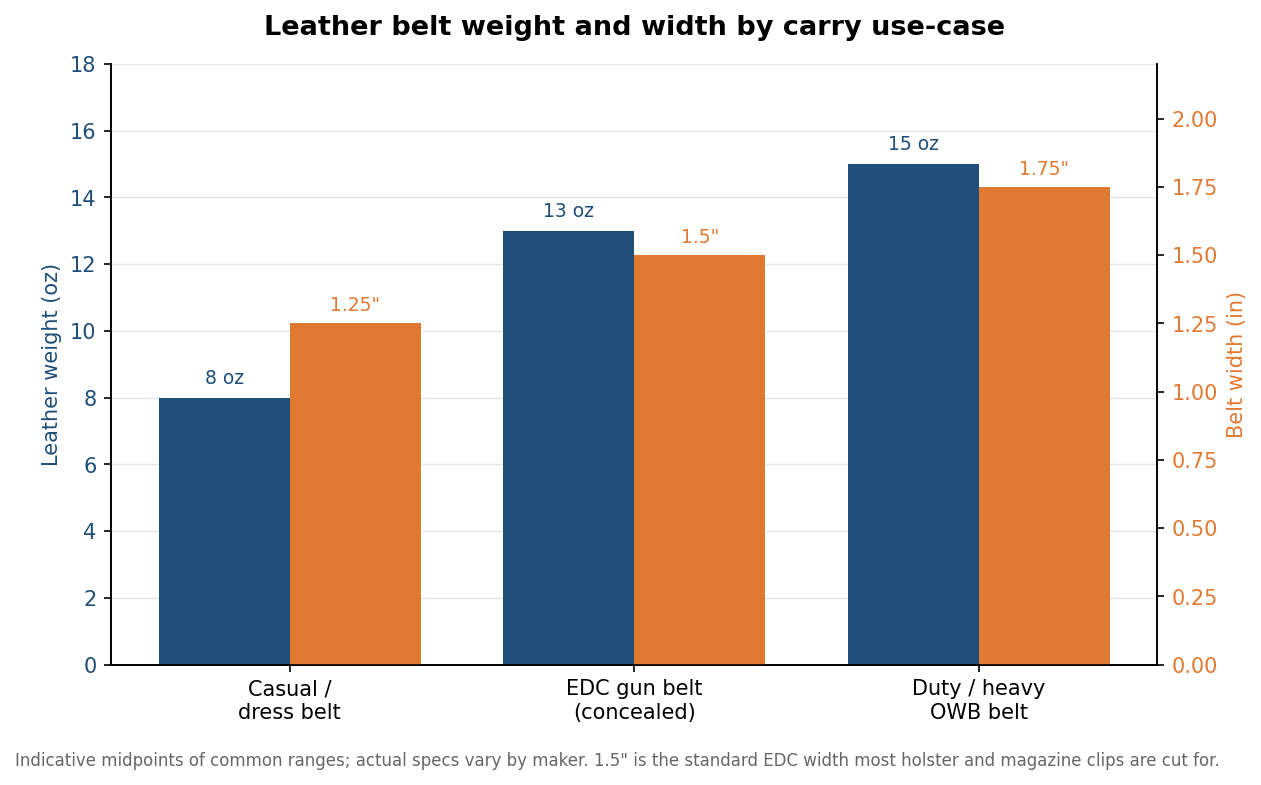
Reading leather weight and width
Leather is sold by weight, quoted in ounces, and that number is really a thickness measurement. The tannery convention is that one ounce equals roughly one sixty-fourth of an inch, or about 0.4 mm. So an 8 oz strap is about an eighth of an inch thick and behaves like a dress belt, while a 12 to 14 oz strap runs closer to three sixteenths of an inch and holds its shape under load. Reinforced belts that laminate two layers, or add a polymer stiffener between an outer and a liner, can reach a quarter inch. Real hides vary by a couple of ounces from the nominal figure, so treat these as ranges rather than exact cuts.
Width is the other number to get right, and here the answer is unusually specific. Most concealed-carry holsters and magazine carriers are cut with belt slots sized for a 1.5-inch belt, which is why 1.5 inches is the default for everyday carry. Go wider and the attachments may not thread on; go much narrower and the holster can shift within the slot. Duty and heavy OWB setups sometimes move to 1.75 inches, but only when the holster hardware is made to match. When in doubt, measure the slot on the holster you already own before ordering the belt.
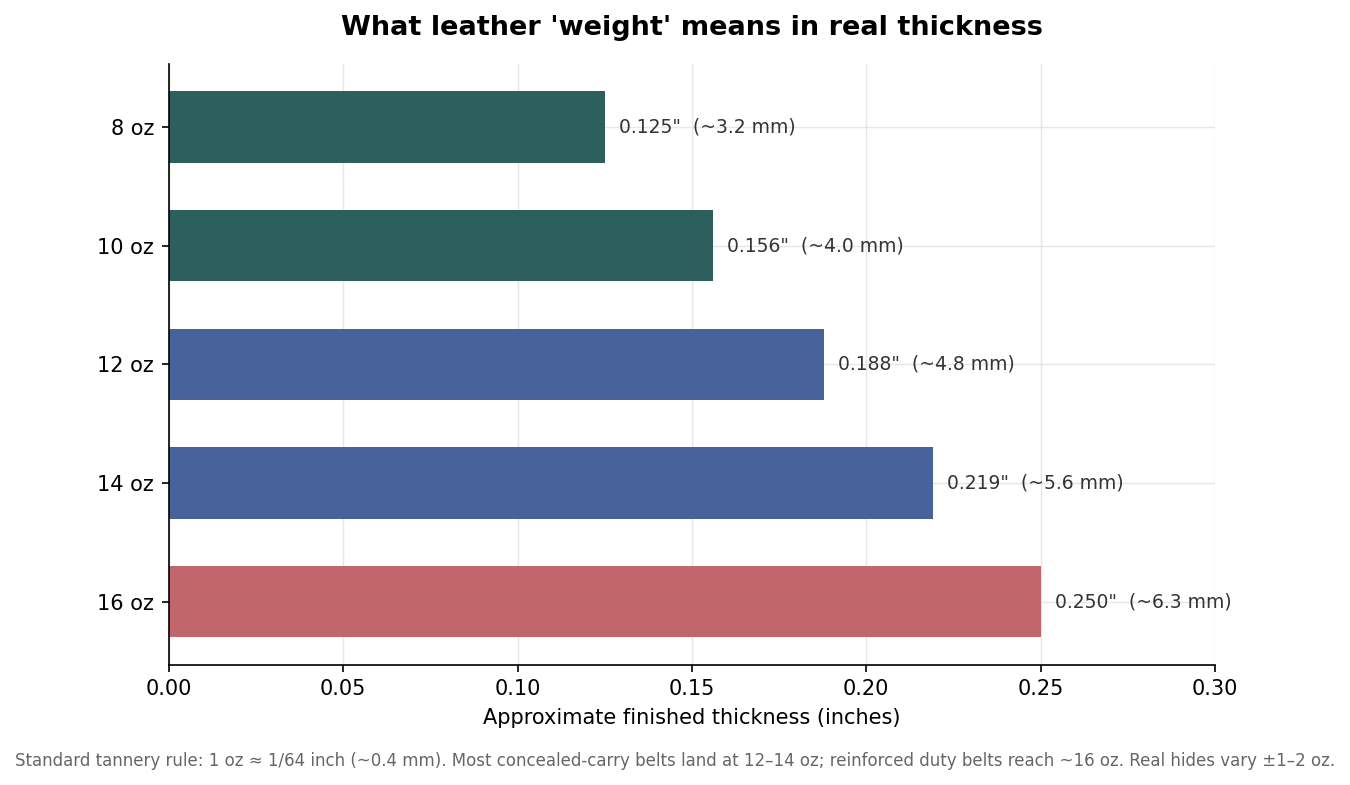
Matching the spec to the situation
For a compact or subcompact pistol carried IWB under office clothing, a single-layer belt in the 10 to 12 oz range at 1.5 inches wide is usually enough. It keeps a dressier profile, still supports a light gun, and threads easily through IWB clips. If you want one belt that passes as a dress belt but can carry, this is the tier to look at, ideally in a firmer vegetable-tanned hide that resists rolling better than a softer chrome-tanned strap.
For a full-size handgun, or for OWB and appendix carry, step up to a reinforced or double-layer belt around 13 to 15 oz at 1.5 inches. The extra rigidity is what stops a heavier gun from pulling the belt into a taco shape over the course of a day. Duty use, where a holster shares the belt with cuffs, spare magazines, and other gear, is the one case for a 1.75-inch belt in the heaviest leather, matched to duty-width holster loops.
Sizing is where most first orders go wrong. A carry belt is not your trouser size. The belt has to travel around your waist and pass through the holster and any inside-waistband attachments, which adds circumference, so order by measuring an existing belt from the buckle fold to the hole you actually use, then add for the holster. Many makers recommend ordering the belt size two inches above your pant waist as a starting point, but the measured method is more reliable. Because a stiff belt cannot be cinched in as forgivingly as a soft one, a belt that is an inch too long or short is a real problem rather than a minor annoyance.
Details that separate a good belt from a great one
Edge stitching that runs along both sides of the belt, rather than a single central line, helps hold laminated layers in alignment and adds durability at the point where the belt flexes most. The buckle should be solid metal and attached so it will not work loose; a heavier buckle is not just cosmetic, since a flimsy buckle undermines an otherwise rigid belt. For adjustment, traditional hole-and-prong belts give you fixed positions roughly an inch apart, while ratchet or tension-lock systems allow finer adjustment across the range, which matters when a stiff belt has little give and your waist changes slightly through the day or with layered clothing.
Finish and hardware are the place to express personal taste, but they should follow the structural decisions rather than lead them. It is worth choosing thickness, width, and construction for your carry method first, confirming the belt will actually fit your holster’s slots, and only then picking the color, buckle style, and stitching that you want to look at every day. A belt specified in that order tends to be the one that still carries comfortably a year later, which is the real test of a concealed-carry belt.